

What should the right and left thyroid lobe dimensions be in mm? In adults, the length of the thyroid lobes evaluated by ultrasonography is generally approximately 40-60 mm. Their anteroposterior and transverse diameters are approximately 13-20 mm. Small differences may be seen between the measurements of the right and left lobes.
What should the right and left thyroid lobe dimensions be in mm? The answer may vary depending on age, sex, body structure, and individual anatomical characteristics. Measurements in an ultrasound report are not evaluated on their own. Thyroid volume, tissue structure, the presence of nodules, and other ultrasound findings are considered together. If measurements fall outside the expected range, the findings are interpreted together with a medical assessment and any necessary laboratory tests.
How Are Thyroid Lobes Measured?
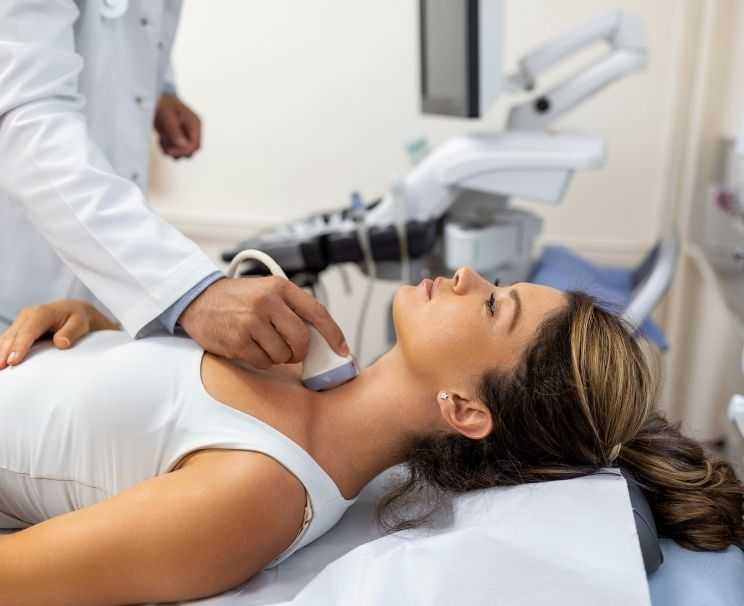
Thyroid lobes are usually measured by ultrasonography. During the examination, the thyroid gland at the front of the neck is visualized, and the right and left lobes are evaluated separately. When determining the right and left thyroid lobe dimensions, measurements of each lobe are taken along different axes. This assessment allows the overall size of the gland and possible size differences between the lobes to be examined in greater detail.
The main measurements evaluated during ultrasound are as follows:
- Length: Indicates the distance between the upper and lower borders of the lobe.
- Width: Refers to the measurement of the lobe in the transverse plane.
- Anteroposterior diameter: Indicates the distance between the anterior and posterior surfaces of the lobe.
When necessary, these three measurements can also be used to calculate thyroid volume. Recording the values obtained for the right and left lobes separately helps with comparison against previous measurements during follow-up examinations and with monitoring changes in size. Taking measurements in the same anatomical planes supports more consistent comparative assessments.
However, the dimensions of the thyroid lobes alone are not sufficient to make a diagnosis. During ultrasonographic evaluation, findings such as the gland’s tissue structure, echogenicity, presence of nodules, borders, and relationship with surrounding tissues are also examined together.
Blood tests are used to evaluate thyroid function. In this context, TSH is one of the basic laboratory parameters used to assess how the thyroid gland is functioning.
How Are Measurement Results Evaluated?
Following a thyroid ultrasound, measurements of the right and left lobes are generally reported in millimeters along three different axes. Specifying the length, width, and anteroposterior diameter separately for each thyroid lobe allows the gland’s dimensions to be evaluated more systematically. These measurements also help compare the right and left sides and, when necessary, calculate thyroid volume.
| Item | Reporting Format | Description |
| Right lobe | Length × width × anteroposterior diameter (mm) | Shows the measurements of the right side along three different axes. |
| Left lobe | Length × width × anteroposterior diameter (mm) | Shows the measurements of the left side along the same axes. |
The right and left lobe measurements are not expected to be exactly the same. Depending on a person’s anatomy, size differences may be present between the right and left lobes. Millimeter measurements in the report should not be considered normal or abnormal on their own.
When ultrasound results are evaluated, the gland’s volume, tissue structure, echogenicity, and the presence of nodules are also taken into account. Changes over time can be monitored by comparing the findings with previous ultrasound examinations.
What Are the Normal Dimensions of the Thyroid Lobes?
When evaluating normal thyroid dimensions, the length, width, and anteroposterior diameter of the right and left lobes are considered. These values are obtained during a thyroid ultrasound and are reported in millimeters. In adults, the lobes are approximately 40-60 mm in length, while the width and anteroposterior diameter are approximately 13-20 mm.
| Lobe | Length | Width | AP Diameter |
| Right lobe | Approximately 40-60 mm | Approximately 13-20 mm | Approximately 13-20 mm |
| Left lobe | Approximately 40-60 mm | Approximately 13-20 mm | Approximately 13-20 mm |
These ranges provide a general framework for evaluation. There is no single normal millimeter value that applies to every individual. Thyroid dimensions can be influenced by age, sex, body structure, and individual anatomical characteristics. The right and left lobe measurements do not need to be identical. Small size differences between the two lobes should not be considered a sign of disease on their own.
Measurements obtained by ultrasound are evaluated together with the total volume of the thyroid gland and other imaging findings. When necessary, changes in size over time can also be monitored by comparison with previous ultrasound examinations.
In addition to the size of the thyroid gland, ultrasonography also evaluates the tissue structure and whether formations such as nodules are present. For more detailed information, you can read our article on thyroid nodules.
Why Can Thyroid Gland Size Change?
The size of the thyroid gland can vary from person to person and may also change over time. This does not always mean that thyroid function is impaired. The gland’s volume can be influenced by factors such as age, body weight, anatomical characteristics, and iodine status. In addition, some thyroid disorders may cause the gland to enlarge or its structure to change.
Some of the main factors that may cause changes in thyroid size include:
- Changes in iodine status: Inadequate iodine intake may be associated with enlargement of the thyroid gland.
- Autoimmune thyroid diseases: Hashimoto’s thyroiditis and Graves’ disease may affect the structure and size of the gland.
- Thyroid nodules: A single nodule or multiple nodules may cause an increase in the gland’s total volume.
- Age and body structure: Thyroid volume may vary according to individual characteristics such as age, body weight, and height.
Pregnancy, hormonal changes, and some inflammatory processes may also cause temporary or permanent differences in thyroid gland volume. When assessing changes in the thyroid gland, considering medical findings and previous results together is more meaningful than relying on a single measurement.
Changes in thyroid size are not interpreted solely on the basis of ultrasound measurements. When considered necessary, a physician may also evaluate laboratory results that reflect thyroid function. For more detailed information about TSH and other hormone measurements, you can read our article on thyroid tests.
Enlarged Thyroid Lobes
Thyroid lobes measuring larger than expected may indicate an increase in the total volume of the thyroid gland. However, this finding alone does not indicate a specific disease. Enlargement may affect both lobes, or it may be more pronounced in one lobe in some individuals. Ultrasound findings are evaluated together with the person’s overall health status and laboratory results.
When the thyroid lobes are found to be enlarged, the following points may be evaluated:
- Distribution of enlargement: It is assessed whether the increase is present only in the right or left lobe or in both lobes.
- Difference between the lobes: Measurements of the right and left lobes are compared to determine whether there is marked asymmetry.
- Total thyroid volume: Length, width, and anteroposterior diameter measurements are used to obtain information about the overall volume of the gland.
- Comparison with previous measurements: If previous ultrasound examinations are available, it can be assessed whether changes in lobe size have increased over time.
Ultrasonography also examines the gland’s tissue structure and the presence of nodules alongside lobe dimensions. When considered necessary, TSH and other thyroid hormone tests are used to evaluate the functional status of the gland.
Small Thyroid Lobes
Thyroid lobes measuring smaller than expected may be associated with a lower thyroid gland volume. However, a small measurement in a single lobe should not automatically be interpreted as a disease. Anatomical differences may exist between the right and left lobes. Measurement results are evaluated together with the overall structure of the thyroid gland and ultrasound findings.
When small thyroid lobes are evaluated on ultrasound, the following points are considered:
- Whether one or both lobes are affected: It is examined whether the reduced size is limited to one side or involves the entire gland.
- Total thyroid volume: Lobe measurements are used to evaluate the overall volume of the gland.
- Tissue characteristics: The structure and ultrasonographic appearance of the thyroid tissue are taken into account.
- Previous results: If earlier ultrasound measurements are available, they are compared to assess how the change has progressed over time.
The size of the thyroid gland and its functional status do not always directly correspond. When necessary, hormone levels are also included in the evaluation. For more detailed information about parameters such as TSH, T3, and T4, you can read our article on normal thyroid test values.
Is There a Relationship Between Thyroid Size and TSH Levels?
There may be a relationship between thyroid gland size and TSH levels. However, this relationship is not direct or the same in every individual. TSH is one of the main hormones secreted by the pituitary gland that regulates thyroid hormone production.
Some studies have reported an inverse relationship between thyroid volume and TSH levels. A large or small thyroid gland does not directly mean that the TSH level is high or low. The gland’s size and structural characteristics and its hormone production status are separate areas of evaluation.
Different factors are considered when thyroid size and hormone values are evaluated together:
- Thyroid volume: It is evaluated using measurements of the right and left lobes obtained by ultrasonography.
- Gland structure: Nodules, tissue differences, and the overall appearance of the gland are examined.
- Laboratory results: Thyroid function is evaluated with blood tests.
- Individual characteristics: Age, body structure, and existing thyroid-related conditions may affect how the results are interpreted.
Ultrasound provides information about the size and structure of the thyroid gland, while TSH measurement helps assess thyroid function. Changes in measurements over time can also be reviewed by comparison with previous results when necessary. These two findings are not used interchangeably and are interpreted together when appropriate.
For more detailed information about the hormone’s function and how it is evaluated, you can read our article on what is TSH.

Does High or Low TSH Affect Thyroid Size?
Changes in TSH levels may be associated with the size of the thyroid gland. However, a high or low TSH value does not necessarily mean that the gland will enlarge or become smaller.
TSH has a stimulating effect on thyroid tissue. In some cases, prolonged TSH elevation may contribute to stimulation of thyroid cells and an increase in gland volume. However, TSH is not the only factor that determines thyroid size. The underlying thyroid disease and structural changes in the gland are also important. The duration of the change and the course of hormone levels may also be considered during evaluation.
A low TSH level also does not necessarily mean that the thyroid gland will be small. For example, in Graves’ disease, the thyroid gland may enlarge even though TSH is suppressed. This is because gland size is related not only to the TSH level but also to the mechanism of the disease. Similarly, hormone results and gland size may not show a one-to-one relationship in different thyroid disorders.
When thyroid size is interpreted, ultrasound findings and hormone results should be considered together. This approach helps provide a more comprehensive assessment of the structural and functional status of the thyroid gland. A TSH value above the normal range may be associated with different thyroid function disorders. For more detailed information, you can read our article on TSH elevation.
For information about TSH values below the normal range, you can read our article on low TSH.
To learn more about tests used to evaluate thyroid function and to plan appropriate laboratory examinations, you can contact Denge Tıp.